
The Skin Edit · Vascular & Laser Education
Why Do I Have
Broken Capillaries on My Face?
Those tiny red veins around your nose or across your cheeks aren't always just another sign of aging. Here's why they appear, what makes them more noticeable, and which treatments may help.
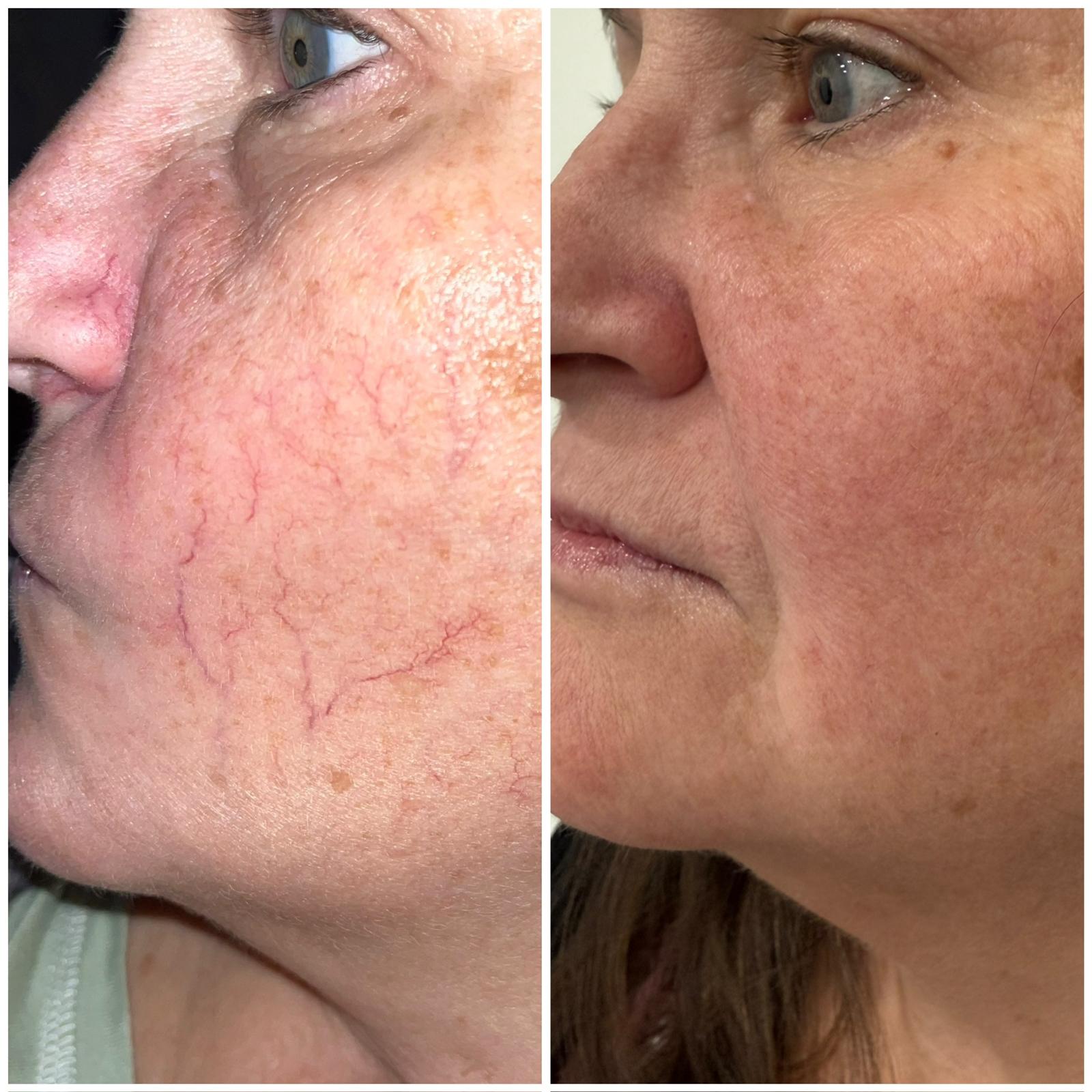
Visible facial telangiectasias reduced with targeted vascular laser treatment. Individual results may vary.
Have you noticed tiny red lines appearing around your nose, across your cheeks, or even on your chin? Perhaps you've been trying different skincare products, hoping they'll disappear, only to find those stubborn little red lines are still there.
You're not imagining things. And no, your skin isn't necessarily protesting your latest birthday.
These visible blood vessels, commonly called broken capillaries, are a frequent skin concern, particularly as we age. While they're generally harmless, they can become more noticeable over time and contribute to persistent facial redness.
The good news? Depending on the cause and your skin type, professional vascular laser treatments may help reduce their appearance.
Clinical Overview
What Are Broken Capillaries on the Face?
Broken capillaries, medically known as telangiectasias, are tiny, widened blood vessels that become visible near the surface of your skin.
Despite their name, these blood vessels aren't necessarily broken. They've become persistently dilated, making them easier to see through the skin.
They often appear as:
- Fine red, pink, purple, or sometimes bluish lines
- Small, branching veins resembling spiderwebs
- Clusters of visible blood vessels around the nose
- Persistent redness across the cheeks
- Tiny thread-like veins on the chin or other facial areas
Facial telangiectasias are particularly common around the nose and cheeks, where blood vessels can be close to the skin's surface.
Underlying Factors
Why Do I Have Broken Capillaries on My Nose and Cheeks?
There isn't always one specific cause. Often, several factors contribute to the development of visible facial blood vessels.
Sun Damage and UV Exposure
Years of sun exposure can affect more than your skin's pigmentation. Ultraviolet radiation damages the skin's supporting structures and can contribute to changes in superficial blood vessels. Over time, these vessels may become more prominent—which is one reason broken capillaries are commonly visible on the nose and cheeks, areas that receive considerable sun exposure.
Aging and Collagen Loss
As we age, our skin naturally produces less collagen and gradually becomes thinner. Collagen provides structure and support to the skin. As that support changes, superficial blood vessels can become more visible. Age-related skin changes can make existing vessels easier to notice.
Rosacea and Persistent Facial Redness
Rosacea is a common inflammatory skin condition that can cause facial flushing, persistent redness, sensitivity, and visible blood vessels. If your cheeks frequently appear red—particularly after exercise, heat exposure, spicy foods, or alcohol—rosacea may be contributing. Not all facial redness is rosacea, and an appropriate assessment can help distinguish visible vessels from other causes.
Genetics
Sometimes your skin has inherited a tendency toward visible facial blood vessels. If close family members have noticeable facial veins or persistent redness, you may be more likely to experience similar concerns. Genetics can influence your skin's characteristics and susceptibility to vascular changes.
Harsh Skincare and Skin Trauma
Aggressive exfoliation, excessive scrubbing, picking at blemishes, and inappropriate use of skincare devices can irritate or injure the skin. Repeated irritation may worsen redness and aggravate already sensitive skin. Your skincare routine should support your skin barrier, not wage war against it.
Temperature Changes and Flushing
Hot showers, saunas, extreme weather, and sudden temperature changes can trigger facial flushing. When you become hot, superficial blood vessels expand to help regulate body temperature. Frequent flushing, particularly in people with rosacea, may accompany increasingly noticeable facial blood vessels.
Alcohol and Lifestyle Triggers
Alcohol temporarily widens blood vessels and may trigger facial flushing, especially in people prone to rosacea. While alcohol isn't the sole explanation for broken capillaries, repeated flushing can make existing redness more noticeable.
Hormonal Changes and Medications
Hormonal fluctuations, including those associated with pregnancy and menopause, can influence skin characteristics and vascular responses. Certain medications, particularly prolonged use of topical corticosteroids on the face, may thin the skin and contribute to visible blood vessels. Always discuss suspected medication effects with your prescribing healthcare professional.
Topicals vs. In-Clinic Care
Can Broken Capillaries on Your Face Go Away Naturally?
Established facial telangiectasias generally do not disappear simply by applying skincare products.
A gentle skincare routine can improve skin comfort, support the skin barrier, and reduce irritation that makes redness more noticeable. However, skincare ingredients cannot reliably close an established, dilated blood vessel.
Products containing ingredients such as niacinamide, vitamin C, or other barrier-supporting compounds may benefit overall skin health, but they shouldn't be confused with treatments designed to target visible vessels.
If your goal is to reduce distinct red veins around your nose or cheeks, professional vascular treatments may be more appropriate.
How Vascular Laser Works
Can Laser Treatments Remove Broken Capillaries on the Face?
Yes. Certain vascular laser treatments can effectively reduce or clear suitable visible facial blood vessels.
Vascular lasers deliver controlled light energy that targets hemoglobin, the pigment found in red blood cells. When the light energy is absorbed, it generates heat within the targeted vessel. This can damage and close the vessel, allowing the body to gradually clear it.
This process is known as selective photothermolysis. The goal is to target the unwanted vessel while minimizing damage to the surrounding skin.
Results Depend On:
- Size, depth & colour of the vessel
- Your skin tone & sensitivity
- The laser technology used
- Underlying cause of redness
- Your individual healing response
Clinical before & after showing marked reduction in visible cheek and nasal capillaries.
Modalities Compared
What Is the Best Laser for Broken Capillaries on the Nose and Cheeks?
Not every laser works the same way. Different technologies are designed to target different types and depths of blood vessels.
Pulsed Dye Laser (PDL)
Commonly used for superficial red blood vessels and certain types of facial redness. May be particularly useful for fine facial telangiectasias and vascular redness associated with rosacea.
KTP Laser
Uses a wavelength that can be effective for small, superficial red vessels. May be suitable for fine, well-defined facial capillaries depending on skin tone.
Nd:YAG Laser
Long-pulsed Nd:YAG lasers (such as the Cynosure Elite iQ™ 1064nm at The Skin Edit) penetrate more deeply and can be useful for selected deeper, purplish, or larger facial and body vessels.
Which laser is best? That depends on your skin and the blood vessels being treated. No single technology is automatically the best choice for every person.
Our Approach at The Skin Edit
How Does The Skin Edit Treat Facial Veins and Skin Concerns?
At The Skin Edit in Abbotsford, our laser facial treatments are performed using advanced Cynosure Elite iQ™ technology, a dual-wavelength laser platform designed to address a range of skin and aesthetic concerns.
Unlike single-wavelength systems, the Elite iQ combines two established laser wavelengths, allowing treatments to be tailored according to skin characteristics and the specific concern being addressed.
755 nm Alexandrite Laser
The Alexandrite wavelength is particularly effective at targeting melanin, the pigment responsible for skin and hair colour.
It is commonly used for laser hair removal and selected pigmentation concerns, depending on skin type and treatment indication.
1064 nm Nd:YAG Laser
The Nd:YAG wavelength penetrates more deeply into the skin and can target hemoglobin within certain blood vessels.
This makes it particularly relevant for selected vascular concerns, including some visible superficial veins. For appropriate candidates, Nd:YAG laser technology may help reduce the appearance of targeted blood vessels through controlled delivery of laser energy.
Why Does Dual-Wavelength Technology Matter?
Not every skin concern responds to the same wavelength, and not every skin type requires the same treatment approach.
Having access to two wavelengths provides greater flexibility when selecting appropriate treatments based on individual skin characteristics.
For clients concerned about visible facial veins, the 1064 nm Nd:YAG wavelength may be considered where the device's treatment indications and individual assessment support its use.
At The Skin Edit, we don't believe in a one-size-fits-all approach to skin health.
Less Hype. Smarter Skin Care.
Our focus is on understanding your concerns, evaluating your skin, and recommending treatments that align with your individual needs.
Is Laser Better Than IPL for Broken Capillaries?
Both vascular lasers and intense pulsed light (IPL) can be used for certain vascular skin concerns, but they work differently.
Vascular Lasers
Use specific, focused wavelengths of light to target blood vessels. Particularly useful for distinct, individual visible veins around the nose and cheeks.
Intense Pulsed Light (IPL)
Delivers a broader spectrum of light. May be useful for selected cases of widespread diffuse redness, sun-related pigmentation, and superficial vascular concerns.
For someone with isolated red veins around the nose, a suitable vascular laser may be preferable. For someone experiencing more widespread redness alongside pigmentation, IPL may be considered.
Can Microneedling Get Rid of Broken Capillaries?
Microneedling and vascular laser treatments have different purposes. Microneedling creates controlled micro-injuries to stimulate collagen remodeling for texture, acne scars, and fine lines.
However, microneedling does not directly close or remove established broken capillaries.
In fact, microneedling may not be appropriate for some people with active rosacea, significant facial inflammation, or highly reactive skin. At The Skin Edit, understanding your primary skin concern is an important part of choosing the right treatment rather than assuming one procedure addresses everything.
Does It Hurt?
Most people describe vascular laser treatment as a brief snapping or stinging sensation against the skin. Devices with integrated cooling technology help protect the skin's surface and maintain comfort.
How Long to See Results?
Visible improvement develops gradually over several weeks. Some small vessels lighten quickly, while others temporarily darken before fading as the body clears them.
Can They Come Back?
A successfully treated vessel may remain closed, but treatment doesn't stop new vessels from forming over time from sun, aging, or genetics. Long-term skin protection maintains results.
Daily Habits
How Can I Help Prevent New Broken Capillaries?
While not every cause is preventable, a few daily habits can support healthier-looking, more resilient skin:
When Should You Have Facial Redness or Visible Veins Checked?
Most small facial telangiectasias are benign, but new or changing skin findings deserve attention. Seek medical assessment if facial redness or visible vessels are accompanied by unexplained bleeding, pain, rapid changes, unusual skin lesions, or other concerning symptoms. Persistent flushing, inflammation, or suspected rosacea may also benefit from assessment by a qualified healthcare professional. Cosmetic treatment should follow appropriate screening rather than replace medical diagnosis.
The Skin Edit by Melissa Jordan
Laser Broken Capillary Treatment in Abbotsford, BC
At The Skin Edit in Abbotsford, we believe effective skin care begins with understanding the concern, not simply choosing a treatment from a menu.
Whether you're noticing fine red veins around your nose, visible capillaries on your cheeks, or persistent facial redness, the first step is determining what may be contributing to those changes. An individualized consultation helps establish whether an available laser treatment is appropriate for your skin.
Less Hype. Smarter Skin Care.
Skin Health. Thoughtfully Edited.
